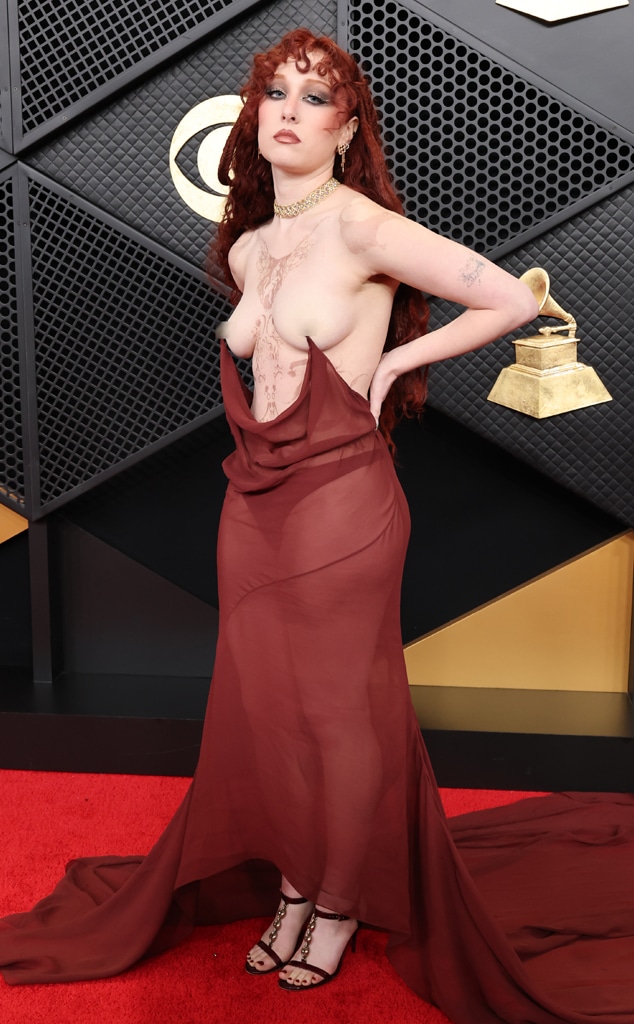
Chappell Roan on Red Carpet Look, Criticism
Chappell Roan arrived at the 2026 Grammy Awards with the unhurried confidence of an artist who understands exactly what she is doing and why she is doing it. By the end of the night, she had become one of the most talked-about figures on the red carpet—not because of a scandal, a misstep, or a calculated controversy, but because she made a choice that felt unapologetically her own. She knew she looked sensational. For her, that knowledge was sufficient.
Still, the court of public opinion is never silent for long.
As images from music’s most prestigious evening flooded timelines and group chats, reactions to the “Subway” singer’s appearance unfolded with predictable intensity. Admiration and incredulity collided in equal measure. Some viewers applauded her fearlessness. Others questioned the necessity of such a daring sartorial statement. The debate, as always, was loud, fragmented, and relentless.
The moment that sparked the frenzy came when Roan stepped onto the red carpet wearing a sheer red Mugler creation that initially suggested drama through concealment. Draped in a flowing cape, the ensemble teased restraint before revealing its true intent. Then, in a single, decisive gesture, the cape was removed. What lay beneath was a vision that felt both futuristic and defiantly primal: a bodice whose structure was anchored not by traditional fabric, but by two gleaming nipple rings connected directly to the garment itself. Her chest and back were left entirely exposed, unshielded and unrepentant.
It was not a wardrobe malfunction. It was not an accident. It was a statement delivered with surgical precision.
Cameras flashed with renewed urgency. Gasps rippled through the crowd lining the barricades. Social media, always hungry, devoured the imagery within seconds. Headlines followed almost immediately, each attempting to frame the look within familiar narratives of shock value, rebellion, or provocation. Yet the outfit resisted easy categorization. It was neither coy nor crude. It existed in a liminal space where high fashion, performance art, and personal autonomy converged.
As the discourse escalated, Roan remained conspicuously unbothered.
When she finally addressed the uproar, her response was disarmingly light. Rather than issuing a manifesto or defending her choices with solemnity, she opted for levity. On Instagram, she shared her thoughts with an amused candor that undercut the intensity of the debate swirling around her.
She admitted to giggling at the reaction, noting that she genuinely did not consider the outfit to be especially outrageous. To her, it was simply strange, inventive, and exciting—qualities she clearly valued. The look, she suggested, was not an affront but an invitation: an encouragement to embrace personal freedom and to revel in the playful absurdity of self-expression. Exercising free will, she implied, could be both joyful and deliciously silly.
The message was unmistakable. The outfit was not designed to appease, shock, or scandalize. It was designed to please its wearer.
Roan’s closing note struck a more traditional tone of gratitude. Nominated for both Record of the Year and Pop Solo Performance, she acknowledged the Grammys themselves and thanked those who had cast their votes in her favor. The juxtaposition was striking. On one hand, she stood as a nominee within the industry’s most formalized system of recognition. On the other, she embodied an ethos that seemed to challenge the very conventions such institutions often uphold.
Fashion, after all, has long served as a battleground for conversations about agency, gender, and the limits of acceptability. Red carpets are not merely pathways into awards ceremonies; they are stages upon which cultural tensions play out in real time. Every hemline, cutout, and accessory is scrutinized, interpreted, and assigned meaning. In this context, Roan’s appearance functioned less as a singular shock and more as a continuation of a long lineage of artists using clothing as a language.
What made her moment distinctive was the absence of defensiveness. There was no attempt to justify the look through references to art history or avant-garde philosophy, though such arguments could easily be made. Instead, there was a breezy refusal to treat the choice as something requiring permission or absolution. The message was implicit but powerful: not everything needs to be explained.
The conversation surrounding the look also revealed familiar fault lines within pop culture commentary. Praise often emphasized bravery and body confidence, framing the outfit as an act of empowerment. Criticism, meanwhile, ranged from discomfort to moral concern, with some questioning whether such exposure was appropriate for an event of the Grammys’ stature. These debates, cyclical as they are, underscored how rarely consensus is reached when artists push against visual norms.
Yet amid the noise, one fact remained indisputable. Roan had succeeded in commanding attention without sacrificing authenticity. The look did not feel like a costume donned for shock value. It felt aligned with the eccentric, boundary-blurring persona she has cultivated throughout her career. In an industry where image is often manufactured through committee, that alignment carried weight.
Interestingly, the singer’s outfit was not the only element of the evening that placed her at the center of conversation. Fellow nominee Sabrina Carpenter offered a wry observation that added another layer to the night’s narrative. According to Carpenter, the photographers lining the red carpet appeared noticeably more restrained than in years past. Her comment, delivered with a knowing humor, hinted at subtle shifts in how celebrity, spectacle, and scrutiny intersect.
Whether that restraint was born of changing industry norms or simple exhaustion is open to interpretation. What is clear is that the red carpet itself is evolving. As audiences grow more accustomed to bold fashion statements, the threshold for what is considered shocking continues to shift. What once would have sparked outrage may now elicit little more than a raised eyebrow. Roan’s own reaction suggested as much. In her view, the look was daring, yes, but hardly unprecedented.
This raises an intriguing question about the nature of provocation in contemporary pop culture. When visibility is constant and novelty is fleeting, how does an artist stand out without resorting to empty theatrics? Roan’s answer, intentional or not, seemed to lie in sincerity. The outfit did not ask to be decoded. It asked only to exist.
There is also something to be said about the physical vulnerability inherent in such a look. To stand nearly topless under the glare of hundreds of cameras requires a level of composure that goes beyond confidence. It demands a willingness to be seen without filters, without armor. In that sense, the Mugler dress functioned less as exposure and more as an assertion of control. By choosing when and how to reveal herself, Roan inverted the typical power dynamics of the gaze.
Critics may continue to debate the merits or implications of the ensemble, but such discussions often miss the broader point. Fashion on the red carpet is not merely about aesthetics. It is about narrative. It is about who gets to define what is acceptable, desirable, or worthy of admiration. By refusing to treat her outfit as transgressive, Roan subtly challenged the premise that it needed to be policed at all.
The Grammys have historically been a site of memorable fashion moments, from the elegant to the outrageous. Some are remembered fondly. Others fade into obscurity. What determines their longevity is not always shock, but resonance. Roan’s appearance tapped into ongoing conversations about autonomy, artistry, and the right to self-definition. That resonance is unlikely to dissipate quickly.
In the days following the ceremony, images of her look continued to circulate, each repost reigniting the debate. Yet Roan herself appeared content to let the conversation unfold without her constant participation. She had said her piece. She had enjoyed herself. That, perhaps, was the most radical aspect of all.
In an era where public figures are expected to contextualize every choice and preempt every critique, her nonchalance felt refreshing. It suggested a recalibration of priorities, one in which personal satisfaction outweighs public approval. The red carpet, often treated as a proving ground, became instead a playground.
Ultimately, Chappell Roan’s 2026 Grammys appearance will be remembered not solely for its visual audacity, but for the ease with which she inhabited it. She did not appear burdened by expectation or rattled by reaction. She appeared present, amused, and wholly herself.
And in a cultural landscape saturated with spectacle, that quiet certainty may be the most striking statement of all.