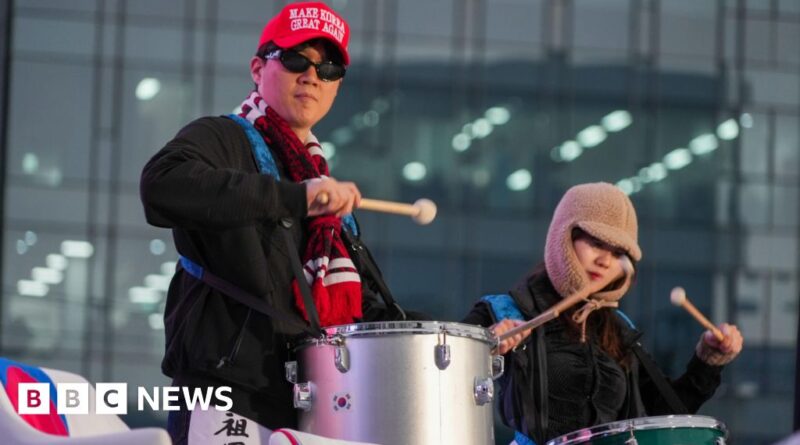
The right-wing group rallying youth in South Korea
Among South Korea’s swelling ranks of anti-government youth protesters, a distinct ideological echo is growing louder—one borrowed from the American right and its Maga movement.
At Seoul’s historic Gwanghwamun Gate, a long queue formed for selfies. The subject was not physically present. Instead, demonstrators posed beside a life-sized photograph of disgraced former President Yoon Suk Yeol.
Yoon himself is behind bars, facing insurrection charges. Yet his absence did little to dampen the fervour of the thousands of mostly young men and women who gathered for a rally organised by the right-wing youth collective, Freedom University.
Led by 24-year-old university student Park Joon-young, the group positions itself against what it describes as an entrenched, corrupt, left-leaning political establishment—one that has promised reform while delivering stagnation, particularly for younger generations.
In Yoon, they have found an improbable symbol.
On the night of December 3 last year, after his party lost its parliamentary majority, Yoon made a last-ditch attempt to reclaim authority by declaring martial law. He ordered troops into the National Assembly and the national election commission, alleging—without evidence—that North Korean sympathisers and Chinese operatives were conspiring to rig elections.
The move collapsed within hours. Enraged citizens blocked advancing soldiers. Lawmakers breached barricades, some scaling walls, to convene inside parliament and overturn the decree.
Yoon was swiftly impeached and now faces trial, with a life sentence a distinct possibility. Politically, it should have marked the end. Instead, for a growing minority, it has transformed him into a martyr.
Former president Yoon Suk Yeol has emerged as a symbol of defiance for disaffected South Korean youth
Never broadly popular—and particularly disliked by younger voters—Yoon has, since his imprisonment, become a totem of resistance for a generation that feels increasingly marginalised.
“When Yoon won, it wasn’t that we were happy a conservative candidate prevailed,” “It was that the left-wing candidate lost.”
He acknowledged that few within the movement approved of Yoon’s performance while in office. But his declaration of martial law, Park argues, resonated because it publicly accused the Democratic Party of abusing power, passing incoherent legislation, and slashing youth-focused budgets.
“We saw that,” he said. “And now we stand with him.”
‘Make Korea Great Again’
Hyung Ki-sang, 28, has attended pro-Yoon rallies since the martial law episode. He says years of political neglect pushed him toward the movement. After encountering Yoon’s claims of electoral fraud—reinforced by YouTube videos purporting to offer proof—he attended his first rally, also organised by Freedom University.
The group mobilised campuses nationwide to oppose Yoon’s impeachment and expanded rapidly, drawing thousands through combative social media campaigns.
Their founding slogans dominate banners and placards: Korea for Koreans. Chinese Communist Party out.
American influence is unmistakable. One sign read Make Korea Great Again. Another declared We Are Charlie Kirk, referencing the young Maga figure assassinated in September.
Polling suggests only about 27% of South Koreans share their pro-Yoon stance. Still, the movement’s ascent reflects a deepening ideological fracture within the country.
The Rise of a Movement
Like many supporters, Park says his political awakening began as rebellion. His father once led a television network perceived as left-leaning; his mother served as an aide to former liberal president Moon Jae-in. His mother and sister, he said, were outspoken feminists who attempted to impose their worldview on him.
During the #MeToo era, Park began questioning those beliefs and gravitated toward right-wing perspectives online.
The American right, he says, provided a template.
Park Joon-young, 24, leads the Freedom University movement
“In Korea, it’s easy to be labelled extreme right and cancelled,” he said. “In the US, figures like Charlie Kirk and Maga speak boldly. We want a platform where debate isn’t punished.”
Park rejects accusations that Freedom University is far-right. Its most effective message, he insists, is simple: Korea belongs to Koreans.
That slogan is paired with allegations against Chinese immigrants—claims of ballot stuffing and violent crime that remain unproven and are firmly denied by the government.
The group also frames President Lee Jae Myung’s attempts to improve relations with Beijing as evidence of political subservience to China.
Park relies heavily on youth-centric digital platforms. He began on EveryTime, an online forum exclusive to university students, before shifting to short-form videos that have gained traction on Instagram, Threads, and YouTube.
National attention intensified in September when Freedom University marched through Myeongdong, a commercial district popular with Chinese tourists and home to China’s embassy. Videos of protesters chanting anti-Chinese slurs spread rapidly online.
President Lee responded by warning that disinformation and hate speech had reached dangerous levels and instructed authorities to pursue criminal sanctions.
Yet the message has landed in a country where Sinophobia is widespread and public sentiment toward China consistently ranks among the world’s most negative.
A Disenchanted Generation
The movement’s appeal is amplified by economic disillusionment. National surveys show young South Koreans are the most pessimistic about the country’s future.
Nearly three-quarters believe the economy is in poor condition. Only about half hold a positive outlook—far fewer than their parents.
Economic growth has hovered between 1% and 2% since the pandemic. Trade tensions with the US and intensifying competition from China have sharpened anxieties. Home ownership among young people has plummeted to historic lows, while median monthly income lingers near $1,600, despite world-class educational attainment.
Youth psychiatrist and author Kim Hyun Soo says resentment toward the Democratic Party runs deep.
“They failed entirely on housing,” he said. “The core grievances are housing and employment.”
Economic strain, a reactionary online ecosystem, and volatile gender politics have created fertile ground for mobilisation. Younger voters are also the least convinced that Yoon’s martial law declaration constituted insurrection—only half of those under 30 believe he is guilty.
“The policies of this government are absurd,” said 26-year-old Bae Jang-won at a Freedom University rally. “They hurt young people. It’s natural that we speak up.”
Economic frustration is fuelling anger among South Korea’s younger generation
Kim warns that without credible alternatives and renewed hope, polarisation will intensify. “We must show them a future worth believing in,” he said.
Back at the rally, 24-year-old Kim Ji-min stood beside his girlfriend, holding a Korea for Koreans placard as she waved a national flag. It was his first political demonstration.
“I was nervous at first,” he said. “But seeing so many young people who feel the same—it feels good.”
Nearby, a girl scarcely in her teens raised a sign with a single message: Never Surrender