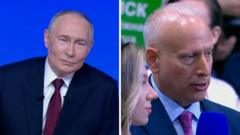
Was Putin’s response to my question about war in Europe an olive branch?
Intercepting a global sovereign for a query is the standard liturgy of the fourth estate. Ordinarily, it is a mundane ritual. Yet, when the interlocutor is Vladimir Putin—the architect of the Ukrainian incursion and the figurehead of a nation recently indicted by the chief of MI6 for the “export of chaos”—the atmosphere thickens with a palpable, electric gravity. To articulate a provocation on live television, under the surveillance of millions of Russian citizens, is to carry a burden of immense proportions. Accuracy is not merely a preference; it is a necessity.
My inquiry concerned the trajectory of the Russian Federation’s tomorrow. I pressed the President on the architecture of the future he envisions for his populace. I posited a series of sharp dichotomies: Will the coming years mirror this stagnant present, where any public divergence from the Kremlin’s orthodoxy invites legal retribution? Is the state poised to accelerate its domestic and extraterritorial purge of perceived antagonists? Should the citizenry anticipate a proliferation of digital blackouts and mobile internet severance? Most crucially, are further “special military operations” looming on the horizon?
While I spoke, Putin remained meticulously engaged, his pen scratching notes across the page. When he finally addressed the room, his rhetoric was a fortress of defense for Russia’s “foreign agent” statutes—a legislative bludgeon that has branded hundreds of dissenters as pariahs. He pivoted to a classic geopolitical tu quoque, claiming the concept was a Western invention, specifically citing American precedents from the 1930s as being far more draconian.
In truth, the Russian iteration is uniquely suffocating. It systematically excises the “foreign agent” from the viscera of public life, barring them from the corridors of the civil service, the sanctity of the classroom, and the legitimacy of the ballot box. It tethers them to crippling fiscal constraints and ensures that a solitary administrative infraction can serve as a catalyst for criminal incarceration. However, I was denied the opportunity for a rebuttal. The apparatus of the state moved swiftly; the microphone was extracted from my grasp the moment my final syllable fell.
The proceedings were abruptly redirected by the moderator. Pavel Zarubin, the anchor, interjected with a query regarding the BBC’s legal tribulations involving a multi-billion dollar litigation initiated by the American executive branch. Putin seized the moment to align himself with the White House’s stance, creating a rare, synchronized moment between the Kremlin and Washington at the expense of the British broadcaster.
Returning to my original interrogation, Putin’s tone shifted. He stated that further military expansions would be unnecessary, provided the West accorded Russia “respect”—a term he used to frame his historical grievances regarding NATO’s eastward encroachment. The subtext of his response was saturated with a profound, calcified resentment toward Western hegemony. He painted a portrait of a Russia consistently deceived and maligned by foreign powers, dismissing warnings of potential Russian aggression against Europe as mere “rubbish.”
This narrative of victimhood, however, is met with profound skepticism across European capitals. Trust has been decimated by a history of obfuscation; one need only recall the vehement denials issued by Russian officials on the eve of the 2022 invasion. Furthermore, contemporary accusations of airspace violations, cyber-espionage, and state-sponsored sabotage continue to fuel the fires of mistrust.
As the session concluded, Putin offered what some might interpret as a diplomatic overture—a conditional olive branch. He signaled a readiness to terminate hostilities, contingent upon the absolute guarantee of Russia’s medium- and long-term security interests. Yet, so long as Moscow’s definition of security remains inextricably linked to its maximalist territorial and political demands in Ukraine, the prospect of a genuine rapprochement remains a distant, flickering mirage.